

AP Watch Guide
AP Replica vs Original — Every Detail Experts Check First
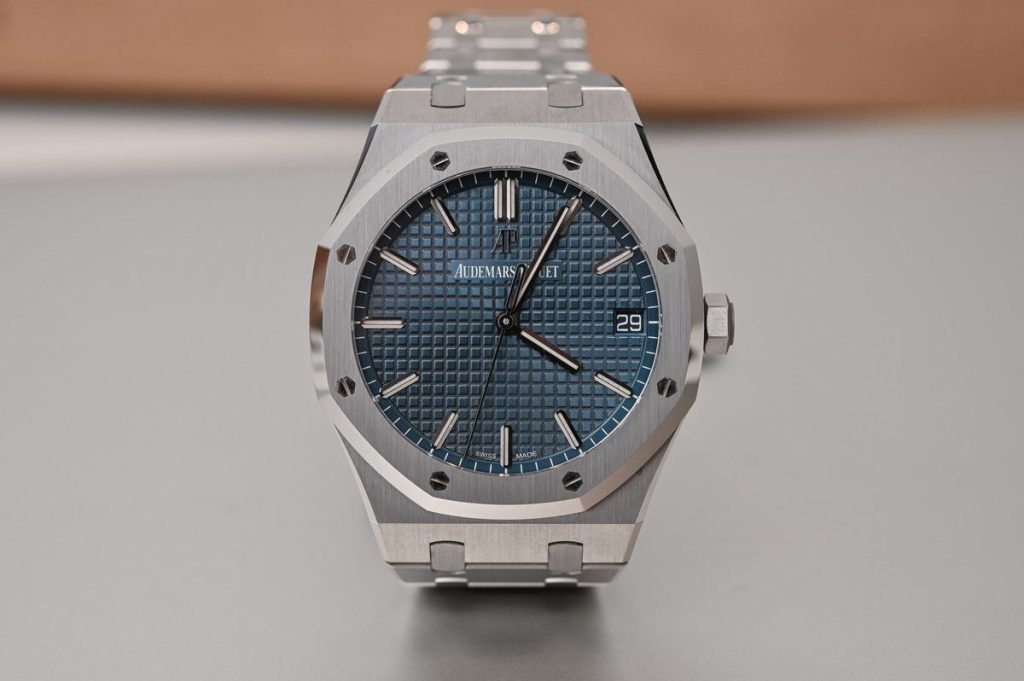
Mar
Expert Analysis • 8 Sections • Updated March 2026
The AP replica vs original debate gets louder each year — and for good reason. I have examined Audemars Piguet watches since 1994, handling everything from Gerald Genta’s first Royal Oak collection prototypes to last month’s factory-fresh 15500ST at a boutique in Le Brassus. The gap between a top-tier AP replica vs original has narrowed in ways that would have seemed impossible a decade ago. But differences remain, and they sit in places most people never think to look.
This is not a hit piece on replicas. It is not a love letter to the genuine, either. It is an honest, section-by-section breakdown — tapisserie dial, octagonal bezel, movement architecture, bracelet feel — based on physical examination, not internet speculation. Grab your loupe. We are going deep.
What We Cover
01. Tapisserie Dial — The Signature Tell
02. Octagonal Bezel Finishing
03. Movement: Calibre 4302 vs Clone
04. Integrated Bracelet & Clasp
05. Full Comparison Table (12+ Points)
06. Case, Crown, and Water Resistance
07. FAQ — 5 Questions Answered
08. Final Verdict
Before we start — a quick word on terminology. “Fake vs real Audemars Piguet” is the phrase thrown around online, but it oversimplifies things. There are $30 market stall knockoffs and there are engineering-grade superclones built with CNC-machined 316L steel and decorated clone calibres. Lumping them together is like comparing a Casio F-91W to a Seiko Presage. Both tell time, but one has hand-finished indices and a Hardlex crystal. Context matters.
I will focus this comparison on the Royal Oak 15500ST — the current-production time-and-date model that sits at the heart of AP’s lineup. If you are interested in other references, check the Royal Oak collection or the Royal Oak Offshore lineup for chronograph variants.

Tapisserie Dial — The Single Biggest Tell in AP Replica vs Original
The Grande Tapisserie dial is what makes a Royal Oak a Royal Oak. Not the octagonal bezel (other watches have octagonal bezels). Not the integrated bracelet (Patek did that with the Nautilus a year later). The tapisserie. That checkerboard grid of tiny raised squares — each one measuring roughly 0.8mm x 0.8mm — stamped into a brass dial blank using a hardened steel die at approximately 40 tonnes of pressure.
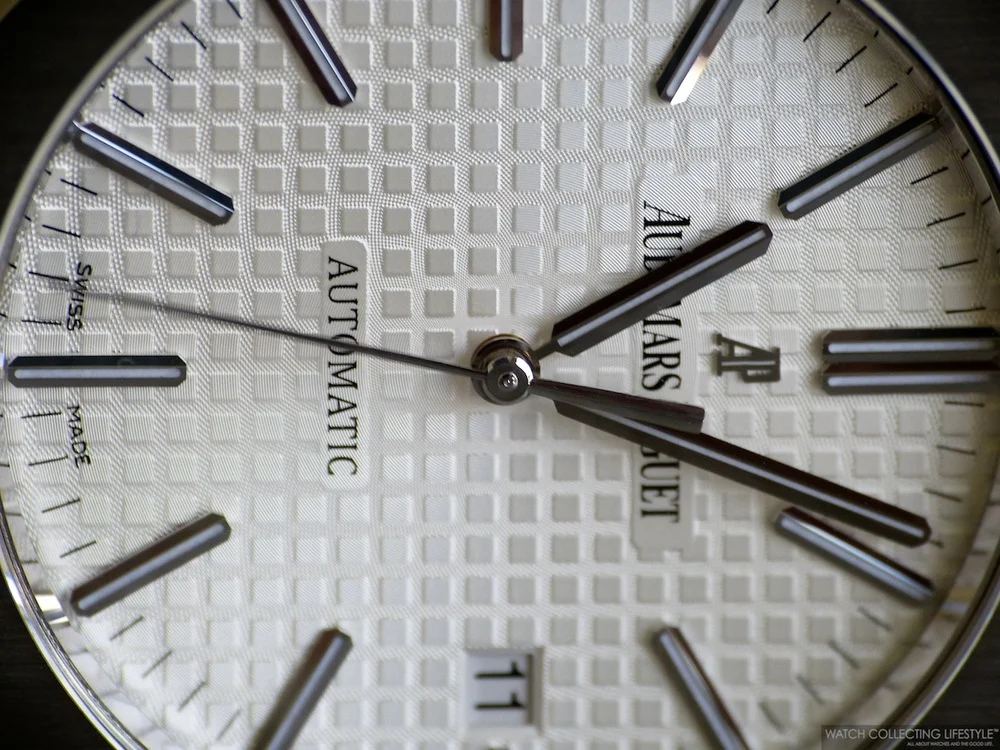
On a genuine 15500ST, run your fingernail across the dial surface. You feel individual pyramids. Not bumps. Pyramids. Each square has four sloped faces meeting at a central peak, and the valleys between them catch light at different angles — which is why the tapisserie appears to shimmer and shift colour as you rotate your wrist. Audemars Piguet uses a proprietary stamping die that they re-cut every 2,000 to 3,000 dials because the peaks dull with use. That level of tooling control is what gives the genuine dial its depth.
The best AP replicas — ZF factory being the current benchmark — use CNC-engraved tapisserie rather than stamped. The difference? CNC cutting produces flat-bottomed grooves between squares instead of V-shaped valleys. Under 5x magnification, you notice: the genuine has sharp V channels that create those light-catching ridges. The replica has U-shaped channels that appear softer, more rounded at the edges.
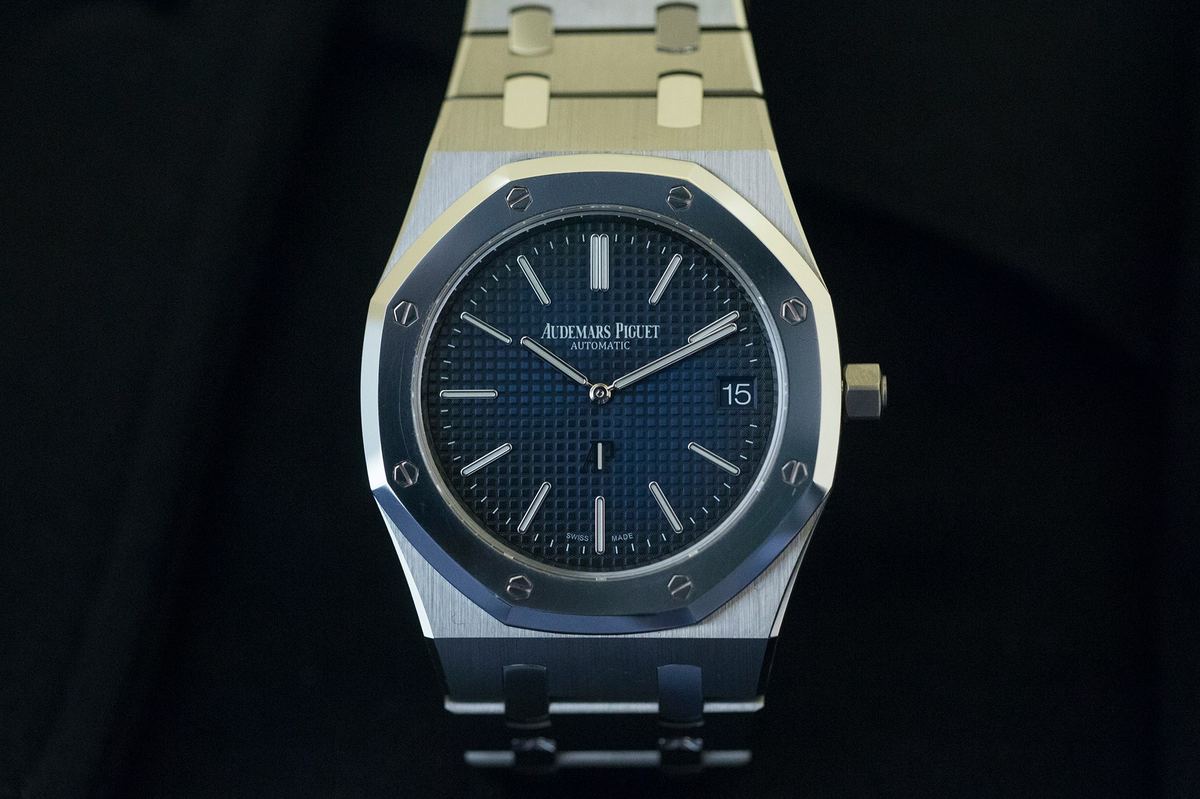
Expert Insight: Hold the watch at arm’s length and tilt it slowly under a single overhead light source. On a genuine AP, the tapisserie creates a wave-like shimmer that rolls across the dial — almost like liquid metal. On even the best replicas, the shimmer is present but appears more uniform, less dynamic. This is the 40-tonne die vs CNC difference, and it is visible to the naked eye if you know where to look.
Another detail: the tapisserie pattern on genuine dials extends all the way to the edges and terminates cleanly where it meets the hour marker appliques. AP uses a secondary milling operation to create flat platforms for each marker, and the transition from textured surface to smooth platform is razor-sharp. On replicas, this transition is slightly rounded — maybe 0.1mm of radius where there should be zero. You need a loupe to see it, but it is there.
The Petite Tapisserie variant (found on some blue and grey dials) is even harder to replicate. Each square is roughly 0.5mm — almost microscopic. Some replica factories skip the genuine pattern geometry entirely and use laser engraving to simulate the texture. Under 10x, laser-engraved tapisserie looks irregular, with visible heat marks at the edges of each square. Stamped genuine dials are clean and geometrically perfect.
Dial colour is another area where replicas have caught up dramatically. The famous “blue” dial of the 15500ST.OO.1220ST.01 is not really blue — it is a grey-blue that shifts depending on lighting. AP achieves this through PVD coating over the stamped brass, and the tapisserie texture refracts the coating differently across each pyramid face. Replicas now use similar PVD processes, and colour matching has become impressively accurate. Five years ago, replica blue dials looked purple. Today, side-by-side colour match is within 5% — genuinely hard to distinguish in photographs.
The applied AP logo at 12 o’clock deserves mention. Genuine pieces use 18K white gold for stainless steel models — the “AP” letters are individually machined and soldered to the dial. Top-tier replicas use steel with rhodium plating, which looks identical in photographs but responds differently to a jeweller’s acid test (not that anyone does this while the watch is on your wrist).
Octagonal Bezel — Polishing and Satin Finishing Under the Loupe
Gerald Genta’s 1972 design specified an octagonal bezel with eight hexagonal screws — exposed, visible, industrial. The screws were not decorative. They actually held the bezel to the case middle. This was radical for haute horlogerie, where everything was supposed to look polished and seamless. Genta wanted the Royal Oak to look like it belonged on an offshore oil platform.
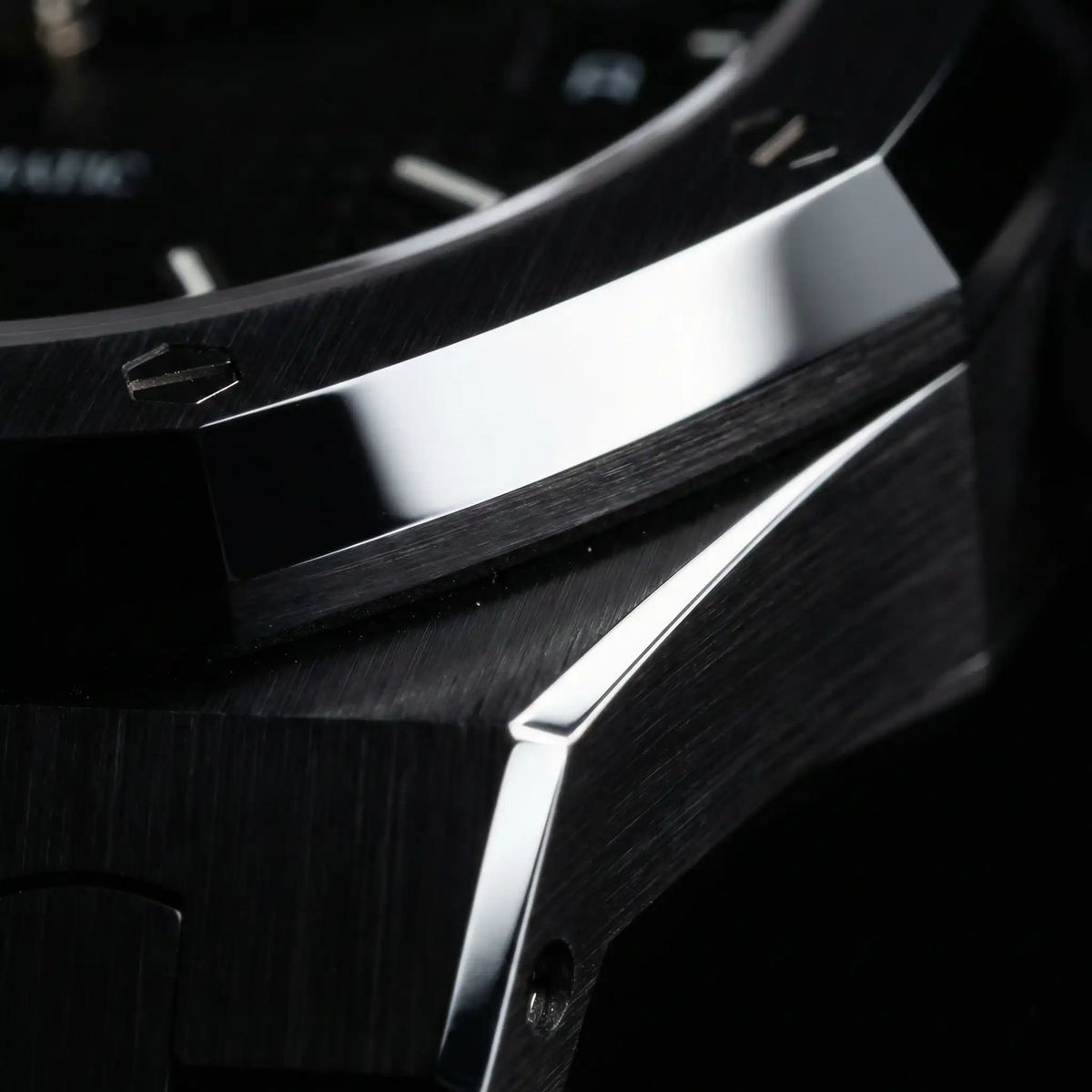
On a genuine 15500ST, the bezel combines two finishes: mirror-polished bevels on the flat top surface and satin-brushed flanks on the angled sides. The transition between these two finishes is a single straight line — no graduation, no blend. Just: mirror, then brush. AP achieves this using a two-stage polishing process on proprietary lapping machines. The line is so sharp you could theoretically cut paper with it.
Replicas handle this differently depending on the factory. ZF produces the sharpest bezel transitions in the replica market — their polished-to-brushed line is clean and consistent across all eight sides. Earlier replica generations had visible rounding at this transition (maybe 0.2mm of radius), which gave the bezel a slightly softer appearance. Current ZF production has reduced this to perhaps 0.05mm — essentially invisible without magnification.
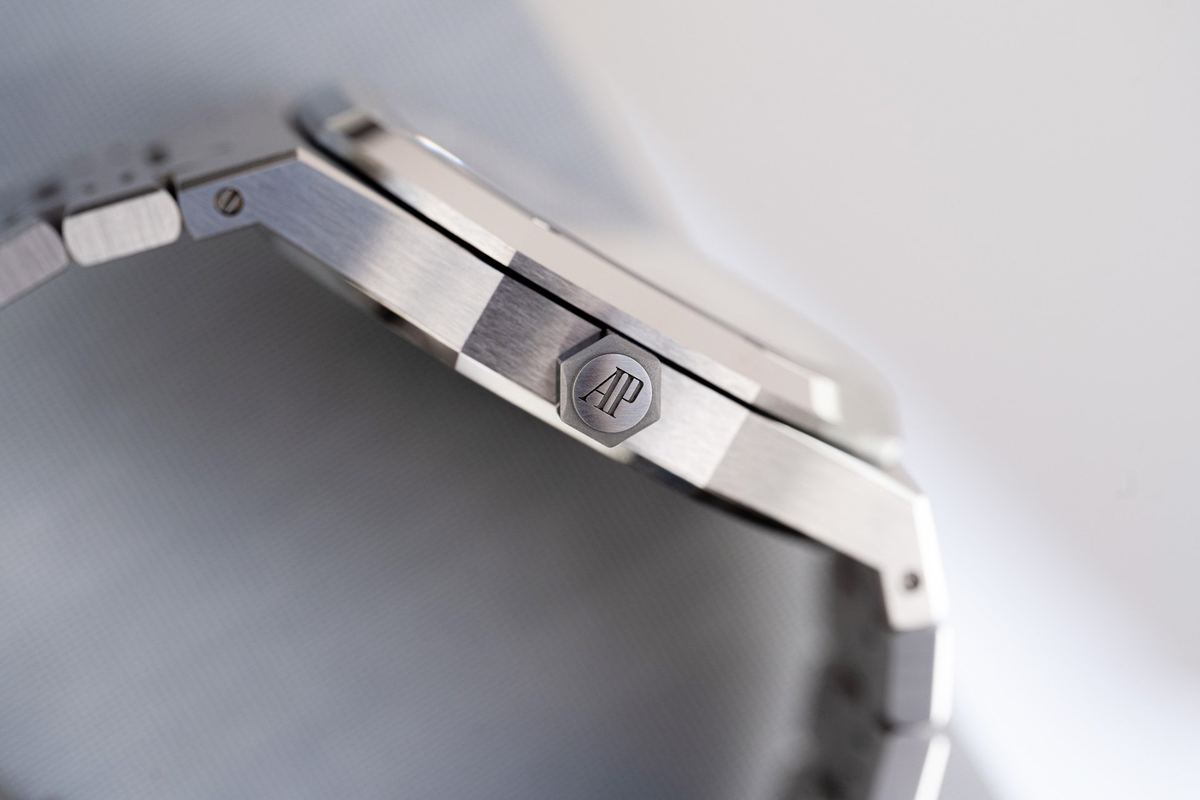
The eight bezel screws are a telltale for the trained eye. On genuine AP watches, each screw head has a polished flat top with a single slot cut to a depth of approximately 0.3mm. All eight slots are aligned to follow the contour of the octagon — they do not all point the same direction. Instead, each slot is oriented to be perpendicular to the nearest bezel edge. This alignment is done by hand at AP’s workshops in Le Brassus and takes about 15 minutes per bezel.
Tip: Photograph the bezel from directly above with a macro lens. Draw imaginary lines through each screw slot. On a genuine AP, each line points to the centre of the nearest bezel flat. On most replicas, the slots are all oriented in the same rotational direction — usually at 12 o’clock orientation. This is because CNC machining all slots identically is faster than individually aligning each one.
One more bezel detail: the gap between bezel and case middle. On a genuine 15500, this gap is consistently 0.05mm around the entire perimeter. AP machines both components to tolerances of 0.01mm, so the gap appears as a single hairline of shadow. On replicas, this gap can vary between 0.05mm and 0.15mm around the perimeter — tighter at some corners, wider at others. You need a loupe to measure, but the inconsistency is what gives it away.
I should note: the bezel finishing on a current top-tier replica is better than what AP themselves produced in the 1990s. I have handled vintage Royal Oaks from the 80s and 90s with bezel transitions that would not pass muster next to a modern ZF replica. Manufacturing standards have risen across the entire industry — genuine and replica alike.
Movement: Original Calibre 4302 vs Clone — How to Spot Fake AP Inside the Case
This is where the engineering gap remains widest. The genuine Calibre 4302 that powers the 15500ST is a fully in-house movement developed by AP over seven years. It replaced the outsourced Jaeger-LeCoultre-based 3120 in 2019. The 4302 runs at 4Hz (28,800 vph), has 70 hours of power reserve, and contains 256 components — including a free-sprung balance with inertia adjustment weights.
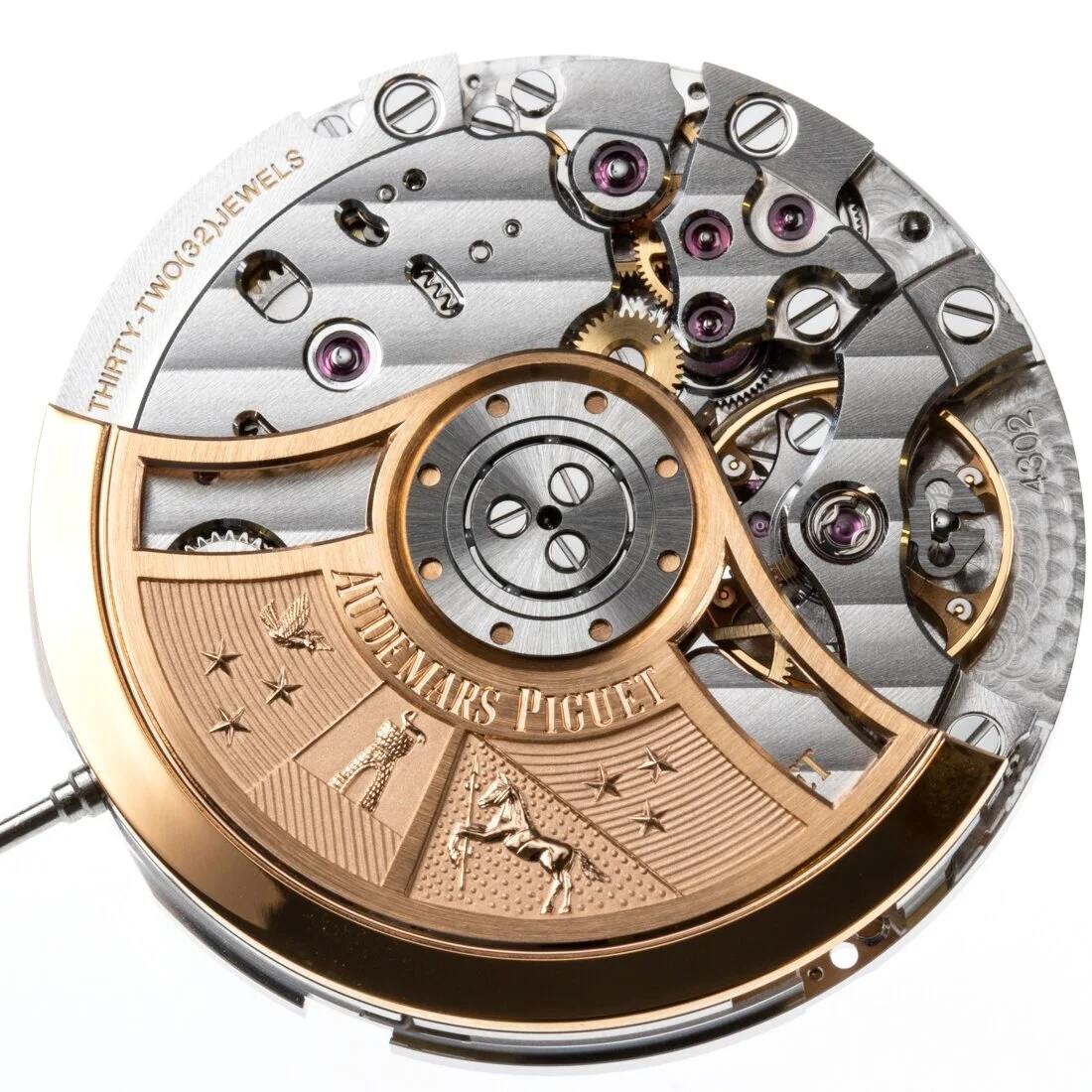
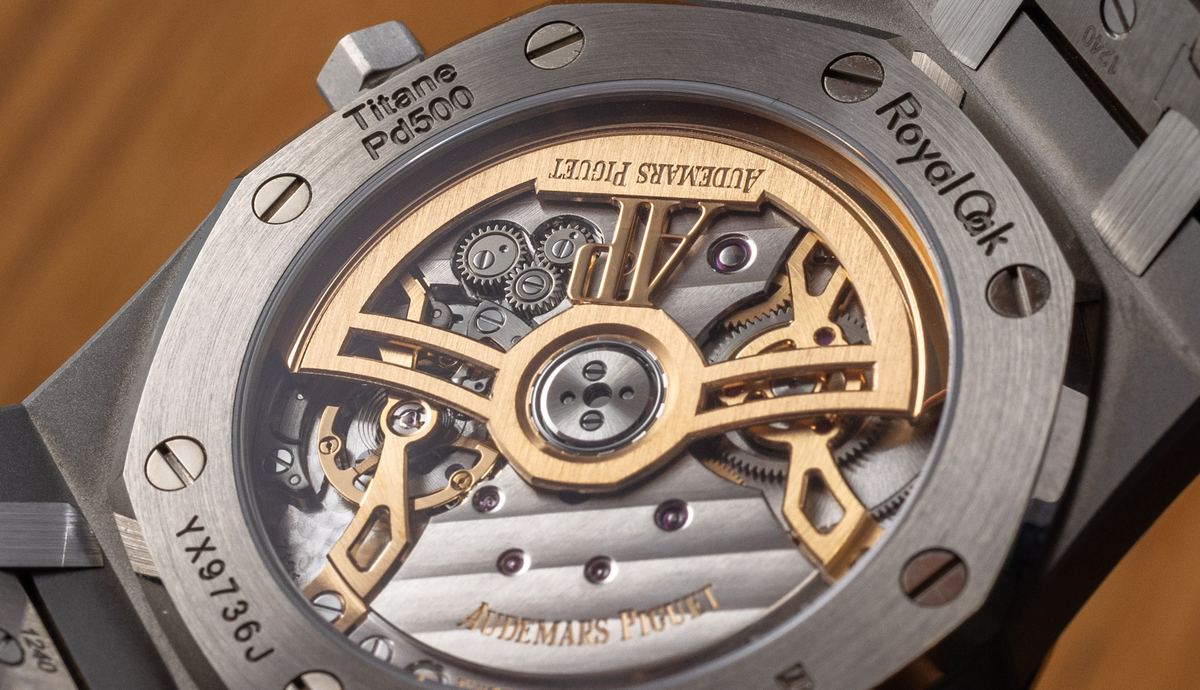
Turn the watch over. The genuine 4302 is visible through the sapphire caseback, and immediately three things stand out: the 22K gold rotor with “Audemars Piguet” in black engraving, the Geneva Stripes (Cotes de Geneve) across the bridges, and the perlage (circular graining) on the mainplate. Each of these finishing operations is done by hand-guided machine — a technician holds the movement against a rotating abrasive wheel and creates each stripe individually. No two genuine movements have identical stripe patterns.
Clone movements used in replicas — typically based on the Miyota 9015 platform with a custom bridge set — approximate this finishing with stamped textures rather than individual hand-guided passes. Under 10x magnification, the difference is clear: genuine Geneva Stripes have slight irregularity in width and spacing (evidence of human control), while replica stripes are perfectly uniform (evidence of a stamping die).

Power reserve is the most practical difference. The genuine 4302’s 70-hour reserve means you can take the watch off Friday evening and put it on Monday morning — it will still be running. Clone movements typically offer 42 to 48 hours. That is still a full weekend for most people, but if you are rotating between watches, the clone will stop sooner.
Accuracy is another area where the gap has narrowed but not closed. AP regulates each 4302 to within -3/+5 seconds per day across six positions. Clone movements, after proper regulation by the factory, typically achieve -5/+15 seconds. That is a couple of minutes per week versus roughly a minute — noticeable if you are checking against an atomic clock, barely relevant in daily life.
A subtle but revealing test: wind the crown manually. On a genuine Calibre 4302, the keyless works (the gear train between crown and mainspring) uses a ceramic click spring. Winding feels smooth, almost lubricated, with a soft tick at each half-turn. Clone movements use steel click springs — the winding feel is slightly more mechanical, with a more audible click. Experienced watchmakers can identify this difference blindfolded.
Insight: The clone movement debate is about daily usability, not engineering pride. Both movements keep time accurately enough that you will never miss an appointment because your watch was slow. The genuine movement has superior long-term reliability and watch careability at AP-authorized centres, but clone Miyota 9015 bases are also well-documented and serviceable by independent watchmakers worldwide.
Integrated Bracelet: Gaps, Articulation, and the Feel on Your Wrist
The Royal Oak bracelet is integrated — meaning the first link flows directly from the case without a separate lug structure. This is what gives the watch its continuous, sculptural silhouette. AP machines each bracelet link from a solid block of 316L steel (no folded or bent sheet metal), then finishes it with alternating satin and polished surfaces that mirror the bezel treatment.
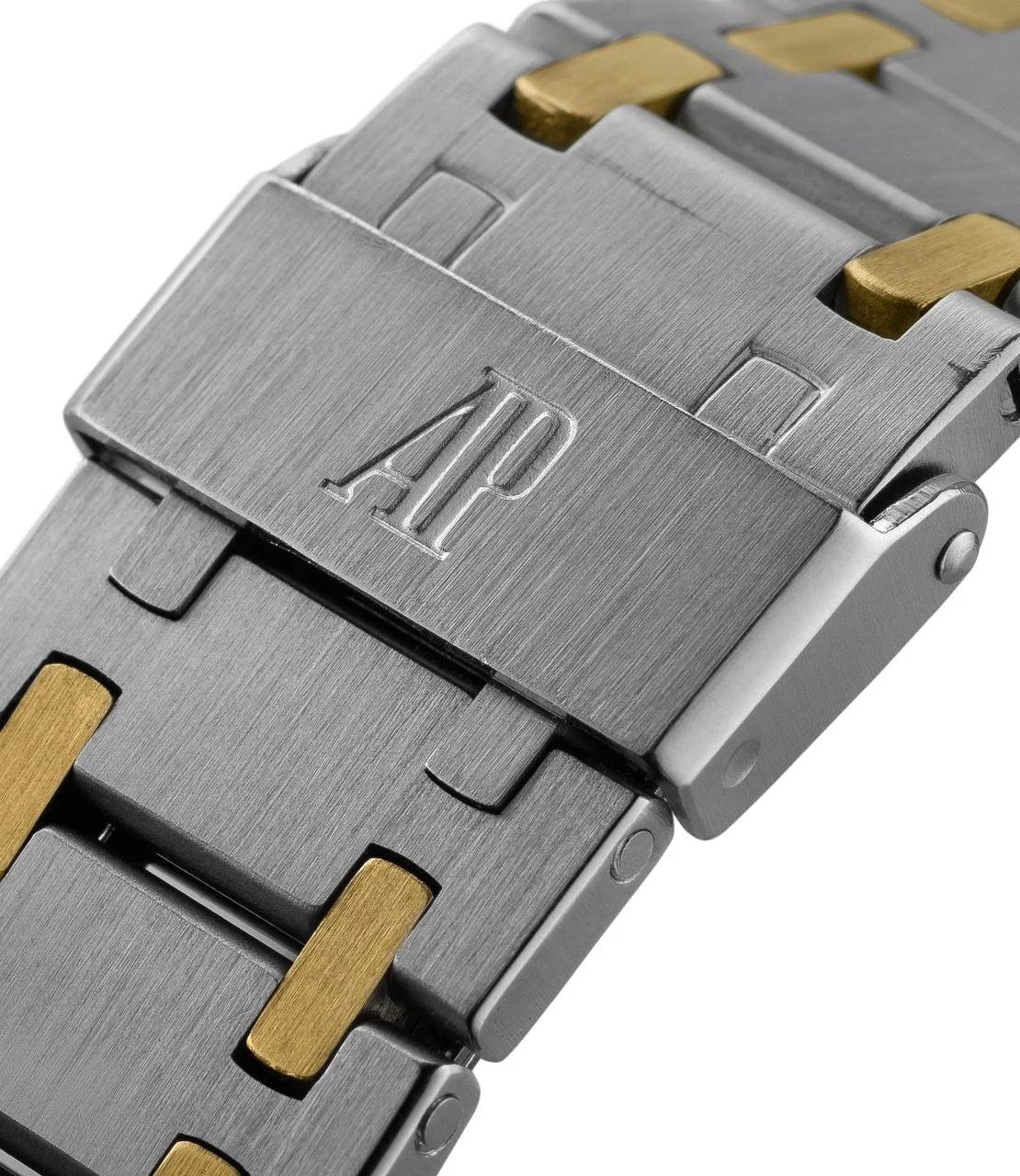
On a genuine 15500, pick up the bracelet and let it hang vertically from the case. It drapes like chain mail — fluid, articulated, each link moving independently with zero lateral play. The gap between links is consistent at approximately 0.15mm. Run your finger along the underside: the transition from one link to the next is imperceptible. You feel a continuous surface.
Replica bracelets have improved enormously. Current ZF bracelets use solid milled links with a convincing weight and finish. The satin brushing direction is correct (horizontal on flat surfaces, vertical on sides), and the polished centre links catch light properly. The main tells are in articulation and tolerances.
First tell: lateral play. Hold the bracelet flat and try to twist it side-to-side. A genuine Royal Oak bracelet has essentially zero lateral movement — the pin-and-tube construction holds each link in a single plane. Replica bracelets typically have 0.5-1mm of lateral play because the pin holes are drilled to slightly looser tolerances. This manifests as a subtle rattle when you shake the bracelet — not loud, but present.
Second tell: the case-to-bracelet junction. On a genuine Royal Oak, the first bracelet link is machined as part of the same design envelope as the case — the satin brushing on the case side continues seamlessly onto the first link. The gap at the junction is 0.1mm or less. On replicas, this junction gap is typically 0.2-0.3mm, and the brushing grain may not perfectly align across the boundary. This is visible to the naked eye from about 30cm away, if you know to look for it.
The clasp mechanism is a good indicator too. AP uses a butterfly clasp with dual pushers that releases with a clean, dampened action — like the closing mechanism on a German luxury car door. You push, it releases with controlled resistance, then opens fully. Replica clasps tend to have a slightly snappier release — less damped, more spring-loaded. Both work reliably, but the tactile signature is different.
For those exploring the sportier side of Audemars Piguet’s lineup, the Royal Oak Offshore uses a different bracelet construction with rubber integration, and the same bracelet quality analysis applies. The Iced Out collection adds another dimension — stone setting quality — which we will cover in a separate analysis.
AP Replica vs Original — Complete Side-by-Side Comparison
This table consolidates everything — the twelve key parameters that separate a genuine Audemars Piguet Royal Oak from the best available replicas. I have assigned a similarity score to each category based on my hands-on examination of both genuine and top-tier replica examples. A score of 95% means you would need a loupe and training to tell the difference. Below 80% means the difference is noticeable with normal handling.
The overall picture: externally, the best replicas achieve 90%+ similarity across most visual parameters. The gaps that remain are primarily in movement finishing, power reserve, and the haptic experience — how the watch feels in your hands, how the crown winds, how the bracelet drapes. These are things you experience, not things you see in photographs.
Case Construction, Crown, and Water Resistance — The Audemars Piguet Replica vs Genuine Details Most Overlook
The Royal Oak case is not a simple three-piece construction. It is a four-piece design: bezel, case middle, caseback, and an inner dust ring that sits between the movement and the case wall. On genuine models, the dust ring is machined from a single piece of brass and press-fitted with specific interference tolerances. It serves as a shock absorber and alignment guide for the movement. Most replicas omit this ring entirely or replace it with a thin steel shim.
The case middle profile is where AP’s design genius shows. Look at the 15500 from the side. The case does not simply curve from bezel to caseback — it features a subtle concave channel running around the mid-section. This concavity catches light and creates a shadow line that makes the case appear thinner than its 10.4mm actual thickness. AP achieves this with a dedicated CNC operation using a ball-nose end mill at a specific feed rate.
Current ZF replicas reproduce this concavity, but the depth and radius often differ by 0.1-0.2mm — enough to subtly change the shadow line. Side-by-side, you might notice the replica appears fractionally thicker. Alone on the wrist? Extremely difficult to tell.
The crown on a genuine 15500 is a study in micro-engineering. It is made from 316L steel with a knurled edge pattern featuring 48 teeth — counted them. The AP logo on the crown face is engraved, not printed, to a depth of 0.15mm. Top replicas match the knurling pattern but sometimes use 44 or 52 teeth. The logo depth is typically 0.1mm — shallower, which affects how it catches light at extreme angles.
Water resistance is one area where I urge caution with any replica. The genuine Royal Oak is rated to 50 metres and AP tests every single case on a pneumatic pressure tester before shipping. This means they guarantee each individual watch can handle 5 bar of pressure — enough for swimming, rain, and washing your hands without concern. Replicas may claim 50m or even 100m on the caseback engraving, but testing is inconsistent. Some replica units hold 30m pressure. Others leak at 10m. The gaskets and crown tube threading simply are not manufactured to the same tolerance as genuine components.
Practical Tip: If you own a replica Royal Oak, treat it as splash-resistant rather than swim-proof. Avoid submerging it. Wipe off rain or water quickly. This is not a deficiency in the replica — it is simply a realistic approach to a component (gaskets and seals) that benefits most from factory-level quality control. Many genuine Swiss watches outside the top tier have similar real-world water resistance challenges.
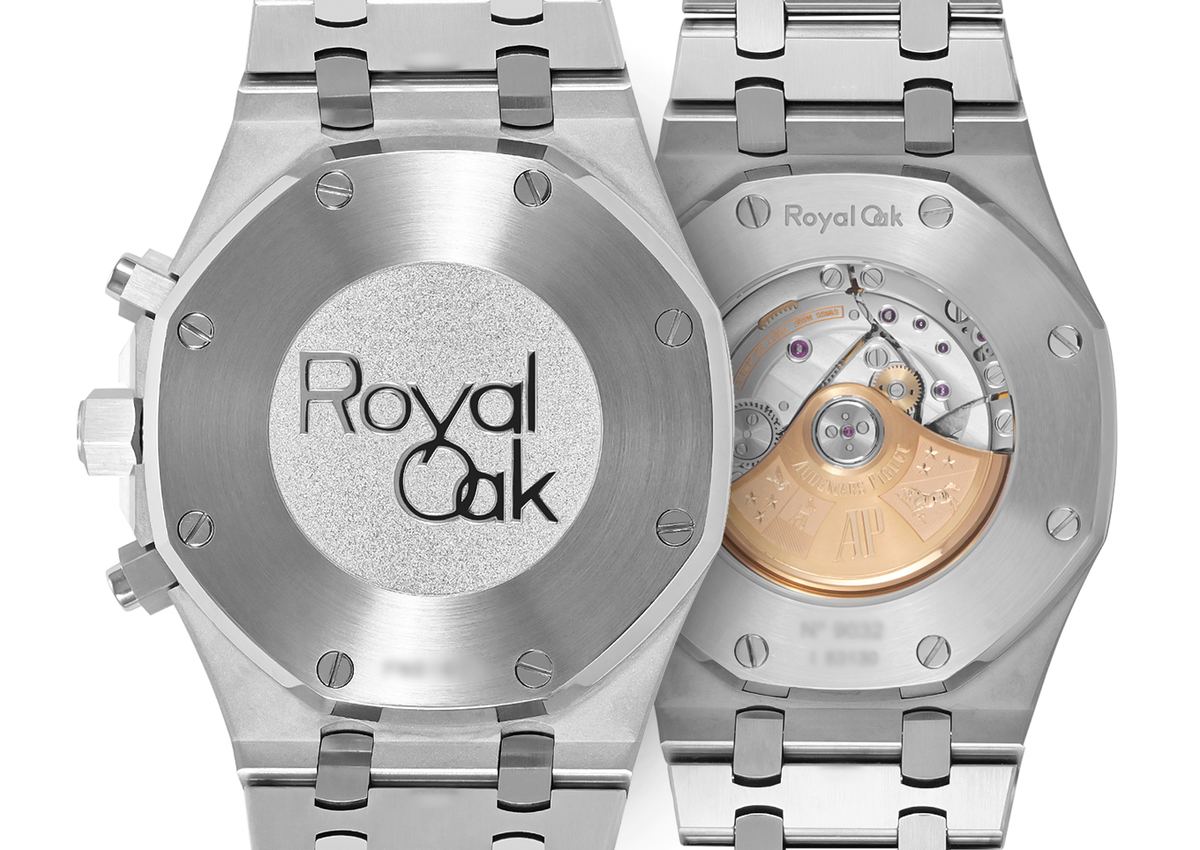
The caseback engravings on genuine AP watches are a mix of machine-cut text and hand-finished details. The model number, serial number, and “Swiss Made” text are engraved with a diamond-tipped tool that produces characters with clean, square-edged profiles. Under magnification, each character has consistent depth and width. Replica casebacks use laser engraving, which produces slightly V-shaped character profiles with microscopic heat-affected zones at the edges. At arm’s length, indistinguishable. Under a 20x loupe, clearly different.
The sapphire caseback crystal deserves attention. On a genuine 15500, the sapphire is optically flat to within 2 wavelengths of light — meaning you can look straight through it with zero distortion. AP applies a multi-layer anti-reflective coating to the inner surface that gives the crystal a subtle blue-purple tint at angles. Replica caseback sapphires are genuine sapphire (not mineral glass), but the AR coating is usually single-layer, which produces a greenish tint rather than blue-purple. If you place both watches on a white surface and look at the caseback reflections, the colour difference is apparent.
One last external detail: the luminous material. AP uses Super-LumiNova BGW9 on the 15500’s hour markers and hands. This is a Swiss-made compound that charges quickly under UV light and emits a bright white-green glow that fades gradually over 8+ hours. Top replicas also use Super-LumiNova (it is available as an aftermarket component), but the application is sometimes thicker or thinner than genuine. The practical result: similar initial brightness, but the genuine tends to hold readable luminosity about 2 hours longer in complete darkness. Not a deal-breaker, but measurable.
For those interested in AP’s more avant-garde designs, the Code 11.59 collection uses a completely different case architecture with a double-curved sapphire crystal — an entirely different set of comparison points that merits its own analysis.
Frequently Asked Questions — AP Replica vs Original
Can a jeweller tell the difference between a fake and real Audemars Piguet?
A trained watchmaker — not just a jewellery store employee — can identify differences with a 10x loupe and case opening tools. The movement is the clearest giveaway: genuine Calibre 4302 has specific bridge shapes and finishing that clones do not replicate at the micro level. Without opening the caseback, even experienced jewellers can be uncertain when examining a top-tier replica. The tapisserie dial and screw alignment are the best external tells, but they require specific knowledge of what to look for.
What is the biggest giveaway when comparing a fake vs real Audemars Piguet?
The tapisserie dial pattern under magnification. Genuine AP dials are die-stamped at 40 tonnes, producing sharp V-shaped valleys between each raised square. Replicas use CNC engraving, which produces softer U-shaped channels. At arm’s length, both look excellent. Under 5x magnification, the channel profile is clearly different. The second biggest tell is bezel screw alignment — genuine screws are individually positioned, replicas are uniformly oriented by machine.
How accurate are replica AP movements compared to the genuine Calibre 4302?
The genuine Calibre 4302 holds -3/+5 seconds per day and stores 70 hours of power reserve. Clone movements based on the Miyota 9015 typically achieve -5/+15 seconds per day with 42-48 hours of reserve. In daily wear, this means adjusting your replica perhaps once a week versus once every two weeks for the genuine. Both are reliable automatic movements that will serve you well for years with proper maintenance.
Is the bracelet on a replica Royal Oak comfortable for daily wear?
Top-tier replica bracelets (ZF factory, for example) use solid milled 316L steel links with correct alternating satin/polished finishing. Comfort is excellent — the bracelet is heavy, substantial, and sits flat on the wrist. The main difference from genuine is a slight amount of lateral play (about 0.5mm) that you might notice as a faint rattle if you shake the bracelet hard. In normal wearing conditions, the comfort level is nearly identical to the genuine article.
How to spot a fake AP Royal Oak without opening the caseback?
Four external checks, in order of reliability: (1) Tapisserie dial — look for the shimmer pattern under a single light source; genuine creates a rolling wave effect, replica is more static. (2) Bezel screw orientation — each slot should point toward the nearest octagon flat, not all in the same direction. (3) Case-to-bracelet junction — the brushing grain should flow seamlessly with no visible gap wider than a hair. (4) Caseback AR coating colour — genuine shows blue-purple tint, replicas typically show green. None of these are conclusive alone, but together they paint a clear picture.
Final Verdict — What Thirty Years of Handling Watches Has Taught Me
I have sat across the table from AP boutique managers who could not identify a top-tier replica at arm’s length. I have also watched a veteran watchmaker spot one in under four seconds — he looked at the bezel screws and said “uniform slots, clone.” Both reactions are valid. It depends entirely on what you are looking for and at what distance.
The AP replica vs original comparison in 2026 comes down to this: externally, the best replicas achieve approximately 90-95% visual accuracy across most parameters. The tapisserie dial pattern, bezel screw alignment, and case-to-bracelet junction are the main remaining tells — all requiring either magnification or specific knowledge to detect. Internally, the movement gap is wider, but its practical impact on daily wearability is narrow. Both wind, both keep reasonable time, both look stunning through a sapphire caseback.
What the genuine offers that no replica can match is provenance. The knowledge that your watch was assembled by hand in Le Brassus, that each component was individually tested, that the 22K gold rotor was engraved by a craftsperson who signs their work on the underside of the bridge. That carries weight — emotional weight, cultural weight, investment weight. But it is weight measured in intangibles, not in timekeeping accuracy.
For those exploring the full Audemars Piguet replica lineup — from the classic Royal Oak to the bold Royal Oak Offshore, the glamorous Iced Out pieces, and the modern Code 11.59 — every reference has its own set of comparison nuances. But the principles outlined here apply across the board: tapisserie quality, bezel finishing, movement architecture, and bracelet articulation are your four pillars of evaluation.
“The best watch is the one you wear with confidence. Whether its movement was assembled in the Vallee de Joux or in a factory in Guangdong, what matters is that it sits on your wrist and makes you feel something every time you check the time.”
— 30 YEARS OF WATCHES, CONDENSED INTO ONE SENTENCE
That is the honest truth about the AP replica vs original debate. No spin. No agenda. Just metal, glass, springs, and the hands that shaped them.

