AP Royal Oak 15400 vs 15500 vs 15510: Every Difference That Actually Matters
Mar
The 15400, 15500 and 15510 are three generations of the same 41 mm Royal Oak: the 15500 brought a new movement and a slightly thicker case in 2019, and the 15510 a new signature, minute track and bracelet in 2022.
On the original watches, 15400 vs 15500 vs 15510 reads like this: Calibre 3120 in a 9.8 mm case, then Calibre 4302 in a 10.5 mm case, then the same Calibre 4302 under a redesigned dial. All three belong to the Audemars Piguet Royal Oak line and keep the octagonal bezel with eight hexagonal screws. This guide compares the three references point by point, using the details Audemars Piguet publishes, so you can see which one suits what you want from a Royal Oak.
If you are looking at a Royal Oak and wondering which reference to pick, this is the question most buyers ask first. The 15400 arrived in 2012 and was replaced in 2019 by the 15500. The 15500 gave way to the 15510 in 2022, the Royal Oak’s 50th anniversary year. Some changes are obvious on the wrist; others you notice only once someone points them out.
Below you will find the specifications side by side, then each generation in turn, the dial and bracelet changes, and a short guide to choosing.
The figures in this guide are for the original Audemars Piguet watches. Our versions are replicas, often called super clones, built to the design of each reference. Each runs an automatic movement with 40 to 48 hours of power reserve, and each product page lists the 41 mm case size. Read the thickness and calibre figures below as the originals’. We explain how our watches differ from an original Royal Oak in a separate guide.
Quick Specs: All Three References at a Glance
✦ marks the advantage for that specification. Thickness for the 15500 and 15510 is taken from Audemars Piguet’s product pages. The 15400 is no longer listed there, so its 9.8 mm comes from the watch press of its time.
Royal Oak 15500 vs 15510: What Changed in 2022
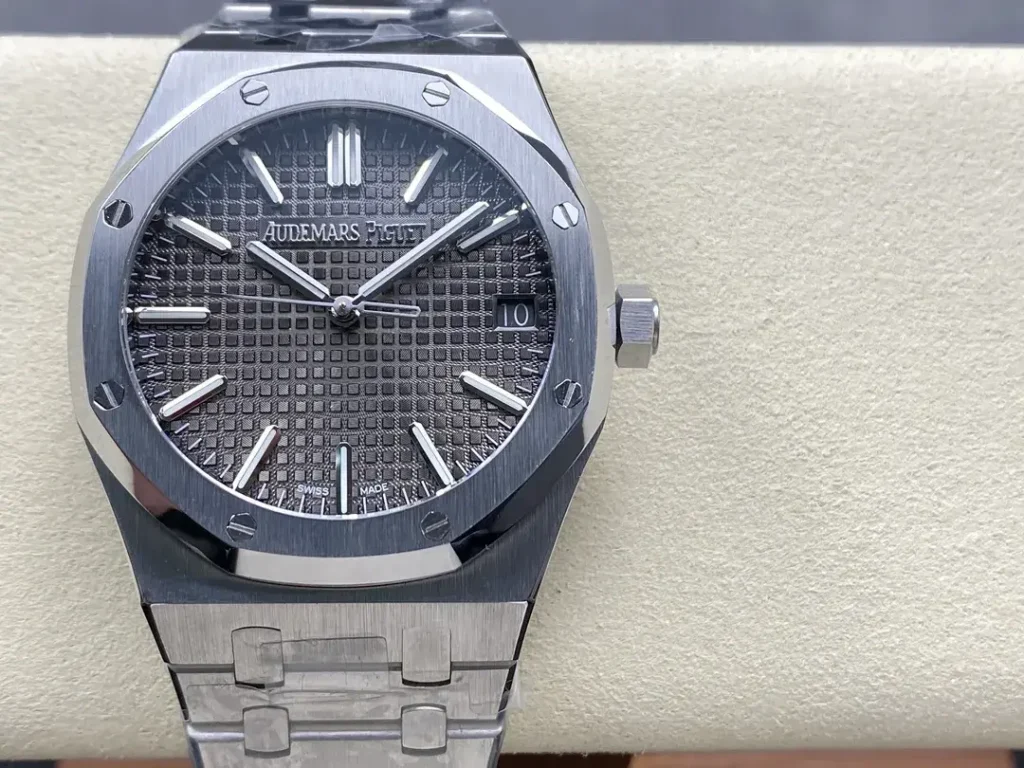
The 15500 and 15510 share the same 41 mm case and the same Calibre 4302, so the AP 15500 vs 15510 choice comes down to the dial, the bracelet and the finishing. In 2022 Audemars Piguet moved the minute track onto the Tapisserie, replaced the AP monogram with a single applied gold signature, slimmed the bracelet links and widened the polished chamfers on the case.
To tell them apart at a glance, look just below 12 o’clock and at the edge of the dial: the AP monogram and a plain minute ring mean a 15500, while a lone signature and minute marks on the Tapisserie mean a 15510. On our watches you can check both details on the photos of your own watch, which we send before it ships.

The Evolution: 15400 → 15500 → 15510
Gérald Genta sketched the Royal Oak overnight in April 1970, and Audemars Piguet presented it at the Basel Fair in 1972 as reference 5402. The 15400, 15500 and 15510 are the three 41 mm generations of its modern time-and-date model, released in 2012, 2019 and 2022. Audemars Piguet sells the current one as the Royal Oak Selfwinding 41 mm.
The 15400 Era (2012-2019): The Slimmest of the Three
The 15400 replaced the 15300 and took the classic Royal Oak from 39 to 41 mm. Inside is Calibre 3120, running at 21,600 vibrations per hour with a 60-hour power reserve. The case is 9.8 mm thick, 0.7 mm slimmer than the two references that followed, and you notice the difference under a shirt cuff.
The dial carried “Automatic” text below the center and the interlinked “AP” monogram. Hour markers were long and thin, and a short baton marker sat at 3 o’clock next to the date window.

Collector’s note: the 15400 left the catalogue in 2019, and its slimmer case is the main reason people still look for it.
The 15500 Transition (2019-2022): New Movement, New Proportions
The 15500 brought a new movement, Calibre 4302. It runs at 4 Hz (28,800 vph) instead of the 15400’s 3 Hz, so the seconds hand moves in finer steps. Power reserve climbed from 60 to 70 hours: take the watch off on Friday evening, put it on Monday morning, and it is still running.
The new movement is also thicker. Calibre 4302 measures 4.9 mm against 4.26 mm for Calibre 3120, and the case grew from 9.8 mm to 10.5 mm to hold it. The diameter stayed at 41 mm, so those 0.7 mm are the whole size difference between the two originals.
On the dial, the 15400ST vs 15500ST difference is easy to see. The AUTOMATIC inscription disappeared, the hour markers became shorter, the date window moved out toward the edge, and the short marker beside it was dropped. The minute track sits on a smooth ring around the edge of the dial, outside the Tapisserie.

The 15510 Refinement (2022-Present): New Signature, Lighter Bracelet


The 15510 keeps Calibre 4302 and the case dimensions of the 15500. Its changes start on the dial.
The AP monogram is gone. In its place is an applied Audemars Piguet signature in 24-carat gold, grown galvanically. The minute track moved off the smooth outer ring and onto the Tapisserie itself, so the pattern runs right up to the edge of the dial. The hour markers and hands were redesigned and harmonized across the 34, 37, 38 and 41 mm Royal Oaks.
The bracelet changed too. Audemars Piguet made every link thinner and lighter, and the first four links now taper more sharply, with a trapezoid profile seen from the side. The polished chamfers on the case are wider, so it looks slimmer although its dimensions did not change. Watches sold in 2022, the anniversary year, also have a 22-carat gold rotor with the “50 Years” logo; later 15510s do not.

Movement Deep-Dive: Caliber 3120 vs Caliber 4302
In the AP Royal Oak 15400 vs 15500 comparison, the movement is the main mechanical difference; the 15510 uses the same Calibre 4302 as the 15500. The figures below are for the original calibres.
Calibre 4302 is wider than the 3120, 32 mm against 26.6 mm, so it fills more of the caseback window and needs a slightly deeper case. The faster beat makes the seconds hand sweep more smoothly, and the extra 10 hours of reserve give more margin when the watch sits unworn over a weekend.
Practical Tip: If case thickness decides it for you, the original 15400 is the slimmest of the three at 9.8 mm, against 10.5 mm for the 15500 and 15510. Between those two, the 15510’s thinner bracelet makes it the lighter watch on the wrist, although the case dimensions are the same. These are the originals’ figures; for one of our watches, ask us for a photo of the case side before you order.

Dial Design: Three Generations of Tapisserie
The Grande Tapisserie is the Royal Oak’s signature dial. Audemars Piguet introduced it in 1999 and makes it on a guilloché engraving machine: a burin follows a master pattern and cuts rows of truncated pyramids into the dial. The Grande version has larger pyramids than the original 1972 Petite Tapisserie, about 380 against 680 to 740.
Each generation handled the tapisserie differently:
15400: Classic Layout
- Grande Tapisserie with integrated minute track on dial
- “Automatic” text below center
- “AP” interlinked monogram at 12
- Long, thin applied hour markers
- Short baton at 3 o’clock, next to the date
15500: Modernized
- Minute track on a smooth ring at the edge of the dial
- “Automatic” removed: cleaner dial
- Shorter hour markers
- No baton at 3, date window at edge
15510: Full Tapisserie
- Minute track runs directly on the Tapisserie
- No AP monogram: an applied 24-carat gold Audemars Piguet signature
- Hour markers and hands harmonised across the 34 to 41 mm Royal Oaks
- Wider polished chamfers
- 22-carat gold “50 Years” rotor only on watches sold in 2022
Dial Colors Available
Dial color: blue is the shade most people picture when they think of a Royal Oak, and the Tapisserie makes it shift as it catches the light. Black is easier to read and goes with a suit or a T-shirt.
Bracelet & Comfort: Where the 15510 Surprises

All three references use the integrated steel bracelet that came with Gérald Genta’s 1972 design, so the case and bracelet read as one piece. The 15510 is the generation where the bracelet changed.
The 15400 and 15500 bracelets are very close. On the AP 15510 vs 15500 question, the bracelet is the difference you feel: every link of the 15510 is thinner and lighter, and the first four links taper more. Our 41 mm Royal Oaks weigh about 155 grams on the bracelet. If you would rather have a smaller case, look at the 39 mm Royal Oak 15202 with a smoked green dial.
Together with the wider polished chamfers, this makes the 15510 look a little smaller on the wrist than the 15500, although the case dimensions are the same.
Which Royal Oak Reference Should You Choose?
Choose the 15400 if…
- You want the generation with the slimmest original case (9.8 mm)
- You prefer the classic “Automatic” dial layout
- You value discontinued-reference exclusivity
- Dress watch versatility matters more than tech specs
Choose the 15500 if…
- You like the newer case and dial layout but want to keep the AP monogram
- You prefer the cleaner dial without “Automatic” text
- You prefer shorter hour markers and the date closer to the edge
- You like the minute track on a smooth ring outside the Tapisserie
Choose the 15510 if…
- You want the Tapisserie up to the edge, with the minute track on it
- A lighter, thinner-bracelet feel matters to you
- You want the latest production reference
- You want a green dial, which only the 15510 offers: see the 15510ST with a green dial
Our view: if you have not owned a Royal Oak before and want the current dial and bracelet, the 15510 is the most refined of the three, and it also comes in a gold-tone version, the 15510OR with a black dial. If you prefer the original 15400 layout with the AUTOMATIC line, choose the 15400. The 15500 sits between them, with the newer movement and the AP monogram kept on the dial.
Wrist Size Recommendations
All three references are 41 mm, so wrist size alone does not decide between them. A 41 mm case suits wrists of about 16.5 to 19 cm (6.5 to 7.5 inches). What differs on the wrist is the thickness and the bracelet of the original watches:
For wrists under 6.5 inches (16.5 cm), the 37 mm Royal Oak 15450 in blue has the same Grande Tapisserie dial in a smaller case.
Frequently Asked Questions
Is the 15400 still worth choosing?
Yes, if a slim case matters to you. The original 15400 is 9.8 mm thick, the slimmest of the three, and its Calibre 3120 is a proven movement. It also keeps the AUTOMATIC text, which the 15500 dropped, and the AP monogram, which the 15510 dropped. For a broader look at which models to start with, see our AP buying guide.
What is the difference between AP 15500 and 15510?
The dial, the bracelet and the case finishing. The 15510 replaces the AP monogram with an applied 24-carat gold Audemars Piguet signature, carries the minute track on the Tapisserie instead of a smooth outer ring, and has redesigned hour markers and hands. Every bracelet link is thinner, so it feels lighter. Mechanically the two are the same: Calibre 4302, 70 hours of reserve and a 41 mm case. Choose by look and feel rather than by movement.
15400 vs 15510: why is the newer Royal Oak thicker?
Because of the movement. Calibre 4302, used in both the 15500 and the 15510, is wider (32 mm against 26.6 mm) and thicker (4.9 mm against 4.26 mm) than the 15400’s Calibre 3120, which took the case from 9.8 mm to 10.5 mm. In return it beats faster, 4 Hz against 3 Hz, and runs longer, 70 hours against 60.
Which dial color is closest between generations?
Blue, black, grey and silver or white dials appear in all three generations. Owners who have put a blue 15500 next to a blue 15510 describe the two shades as very close; the 15510 blue is the one Audemars Piguet calls Bleu Nuit, Nuage 50, applied by PVD. Green is found only on the 15510.
What is the water resistance of these Royal Oak models?
Audemars Piguet rates all three references to 50 m; that is the rating of the original watches. Ours are a different matter: rain and hand washing are fine, but keep them out of the pool and the shower, with the crown screwed in.
Final Verdict
The 15400 vs 15500 vs 15510 question has no single winner. The 15400 suits someone who puts a slim case and the classic dial first. The 15500 suits someone who wants the newer movement with the AP monogram still on the dial. The 15510 suits someone who wants the latest dial, the lighter bracelet and the current reference.
What the three share is the 41 mm octagonal case that grew out of Gérald Genta’s 1970 sketch, the eight hexagonal screws on the bezel, the integrated bracelet and the Grande Tapisserie dial.
You can see the 15400ST, 15500ST and 15510ST in several dial colors in our AP Royal Oak replica collection, for example the 15400ST with a white dial, the 15500ST in white on a rubber strap and the 15510ST with a grey dial.

