

AP Watch Guide
AP Royal Oak Two-Tone & Rose Gold — Complete Model Guide
Apr
By a collector who has spent thirty years weighing the difference between steel and gold on his wrist
The AP Royal Oak collection rose gold replica occupies a territory that no other sports watch has claimed quite as convincingly. Steel made the Royal Oak famous. But rose gold — that warm, coppery alloy that Audemars Piguet has turned into a signature — made it irresistible. Two-tone combinations of steel and rose gold sit right in between, giving you the warmth of precious metal with the everyday confidence of stainless steel on your wrist.
This guide covers every gold Royal Oak worth knowing: full rose gold references like the 15500OR and 15202OR, the increasingly popular two-tone steel-and-gold variants, classic yellow gold models, and the material science that explains why Audemars Piguet’s 18k pink gold actually looks different from everyone else’s. I have handled hundreds of these watches across three decades. Grab a drink and settle in.
Two-Tone in Watchmaking — The Steel and Gold Tradition
Two-tone watches have a reputation problem. Say “two-tone” to most younger collectors and they picture their uncle’s 1987 Datejust — the one sitting in a drawer somewhere, yellowing gold plate on the bezel, quartz battery long dead. That image did real damage. For about fifteen years, from the late nineties through the early 2010s, two-tone was considered almost embarrassingly dated. Nobody under forty wanted steel and gold together on the same wrist.
Then something shifted. Around 2016, a handful of collectors and dealers started noticing that vintage two-tone Pateks and APs were selling for surprisingly strong numbers at auction. The watches hadn’t changed. Taste had. A new generation discovered what the previous one already knew — mixing metals creates visual depth that a single material simply cannot achieve. Light hits a brushed steel surface one way and polished rose gold another. Your eye catches the contrast before your brain even processes what it’s looking at. That interplay is the entire point.
Rolex popularized two-tone watchmaking in the 1930s with the “Rolesor” combination — steel case, gold bezel, gold crown, gold center bracelet links. It was a commercial masterstroke: precious metal where you could see it, steel where you couldn’t. Audemars Piguet took a different path. When AP introduced two-tone Royal Oaks in the 1980s, they treated the combination architecturally. The bezel screws alternated materials. The bracelet links created a rhythm of steel-gold-steel. The tapisserie dial dial reflected both metals’ colors simultaneously. It wasn’t about cost savings. It was about creating a third aesthetic that neither metal achieved alone.
Historical Note: The first two-tone Royal Oak appeared in the late 1970s as ref. 4100SA — steel case with yellow gold bezel and bracelet center links. “SA” in AP’s reference system stands for “Steel/Au” (gold). Modern two-tone references ending in “SR” denote steel combined with rose gold. This naming convention has remained consistent for over forty years.
The current two-tone trend is not a trend at all. It is a correction. The mono-material obsession of the 2000s — all-steel Submariners, all-steel Royal Oaks, ceramic everything — was the anomaly. For most of mechanical watchmaking’s history, mixing metals was standard practice. What AP has done with their audemars piguet two-tone Royal Oaks is simply remind people what they already liked before the fashion cycle told them to forget.
And here is the part that matters for the Royal Oak collection specifically. Gerald Genta’s octagonal bezel design — those eight exposed screws, those sharp geometric lines — was made for two-tone execution. When the bezel is rose gold and the case is steel, every angle of the octagon becomes a transition point between warm and cool tones. The screws pop. The contrast highlights the architecture that Genta spent an entire evening perfecting in 1970. Steel-only Royal Oaks are stunning. Two-tone Royal Oaks are theatrical.
AP Royal Oak Two-Tone Models — Steel and Rose Gold Combinations
Audemars Piguet’s current two-tone Royal Oak lineup pairs 904L-grade stainless steel with 18k pink gold. The specific references that matter — and the ones that get requested most frequently — break down by size, dial color, and which parts receive the gold treatment.
Reference 15550SR — The Current 41mm Two-Tone
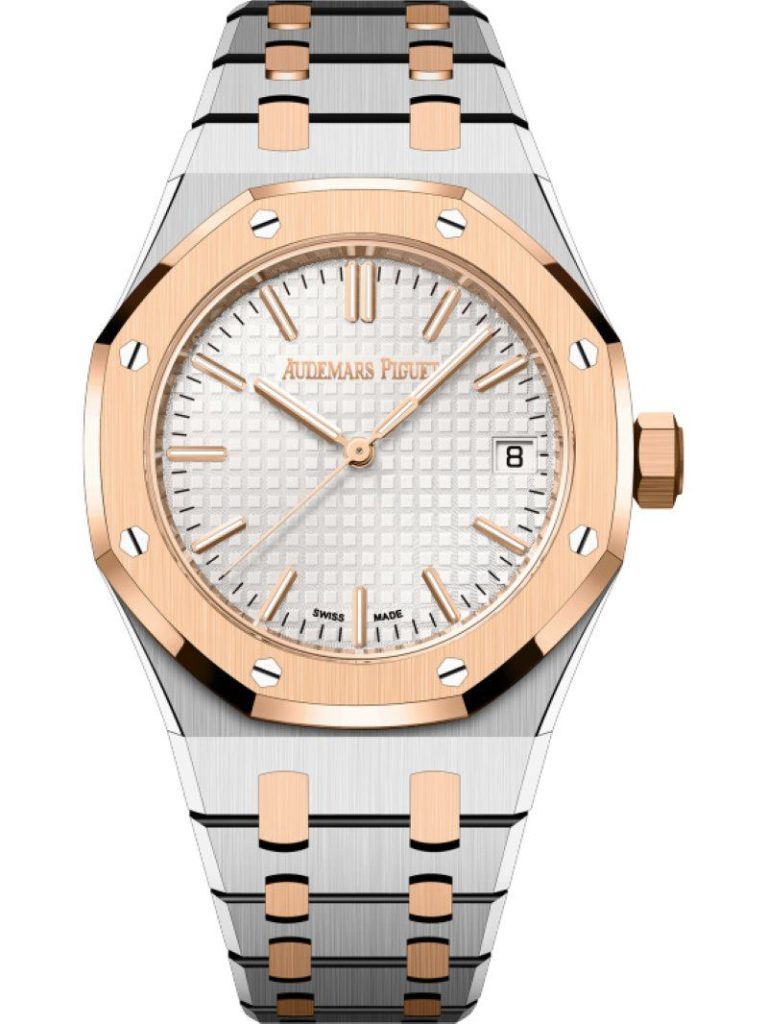
This is the watch that brought two-tone back to the Royal Oak mainline. Introduced in 2023, the 15550SR carries the current-generation movement craftsmanship 4302 automatic movement with 70 hours of power reserve. The “SR” suffix tells you exactly what you are getting: steel case with rose gold bezel, crown, and alternating bracelet center links. The case measures 41mm across and 10.4mm thick — identical proportions to the all-steel 15510ST.
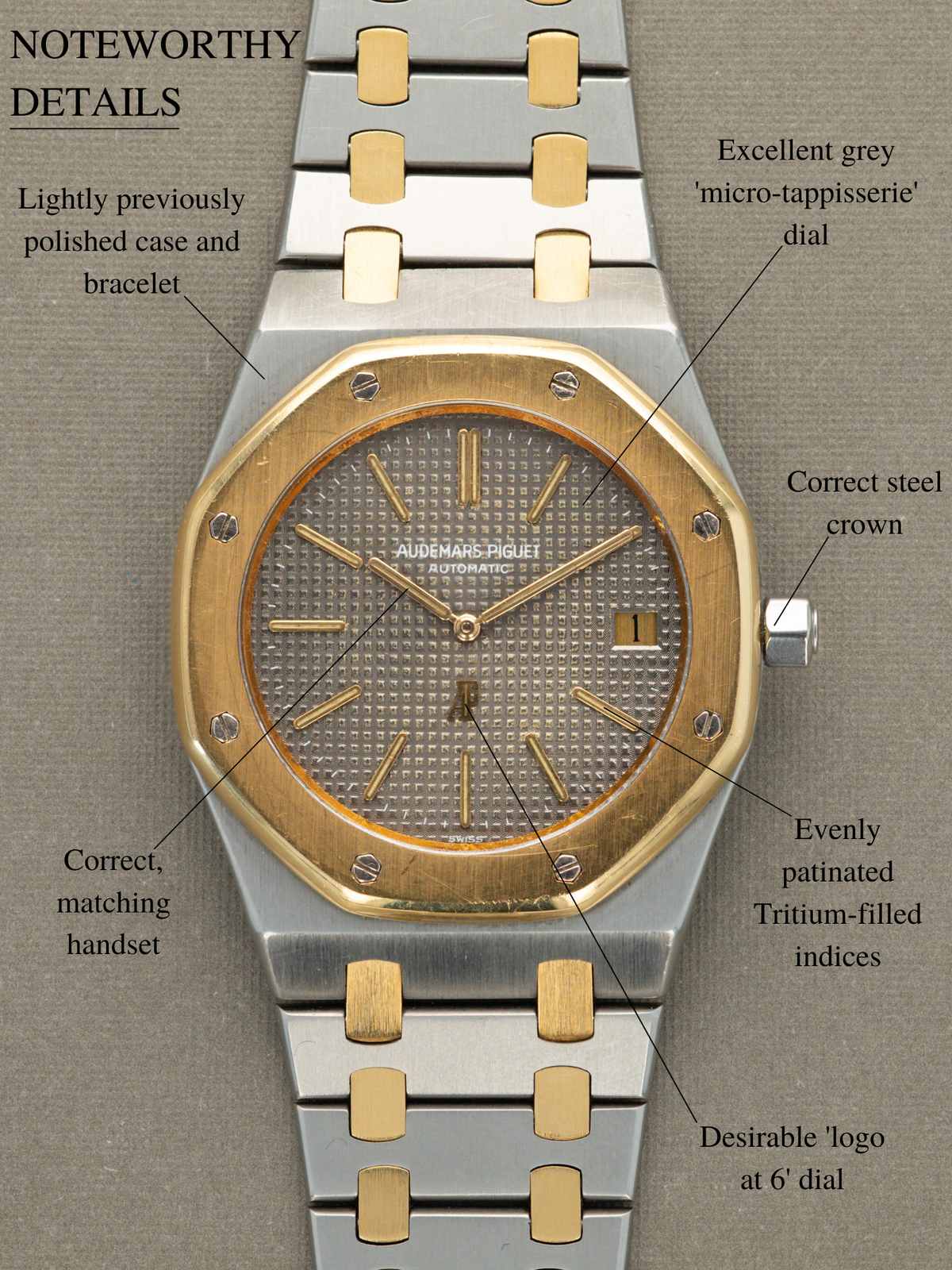
What makes the 15550SR work so well is restraint. AP did not dip every available surface in gold. The bezel is rose gold, yes. The screws are rose gold. The center bracelet links — every other one — are rose gold. The crown is rose gold. But the case sides, the caseback, and the outer bracelet links remain steel. This creates a specific visual cadence when you look at the bracelet from above: steel-gold-steel-gold-steel. It reads as intentional, not excessive. The AP gold watch replica in this two-tone configuration has become one of the most requested pieces over the past eighteen months, and that tracks perfectly with market demand for the genuine article.
Dial options include silver-toned (the classic choice that lets the metal contrast do the talking), blue (a crowd favorite that adds a third color dimension), and slate grey. The grey dial on a two-tone bracelet is the sleeper pick. It matches neither the cool steel nor the warm gold — instead it mediates between them, creating a remarkably balanced look on wrist.
Reference 26240SR — Two-Tone Royal Oak Chronograph
If you want the chronograph but prefer mixed metals over full steel, the 26240SR delivers exactly that. This is the 41mm Royal Oak chronograph — three subdials, integrated flyback chronograph, caliber 4401 with a column wheel mechanism visible through the sapphire caseback. The gold treatment follows the same formula as the 15550SR: bezel, crown, pushers, and alternating bracelet links in 18k rose gold.
I have worn the 26240SR next to the all-steel 26240ST on separate wrists (a ridiculous exercise, but I was at a trade show and nobody was looking). The two-tone piece has maybe 15 grams more weight due to the gold components, and you feel that difference. Gold is denser than steel. That extra heft in the bezel specifically changes the balance point — the watch sits slightly differently on your wrist, anchored a fraction more by the top-heavy precious metal. Some people love that. Others do not notice. But it is real and measurable.
Vintage Two-Tone References — 14790SA and 15000SA
Before the current generation, AP produced two-tone Royal Oaks in the “SA” configuration — steel with yellow gold. The ref. 14790SA (36mm, produced from 1992 to approximately 2006) is a watch that flies under the radar but wears beautifully on smaller sizes wrists. The 15000SA was its predecessor, same 33.5mm size as the very early Royal Oaks but with a more modern movement. These vintage references are worth knowing because they show how long AP has been doing two-tone — this is not a reaction to Instagram trends. It is a tradition stretching back four decades.
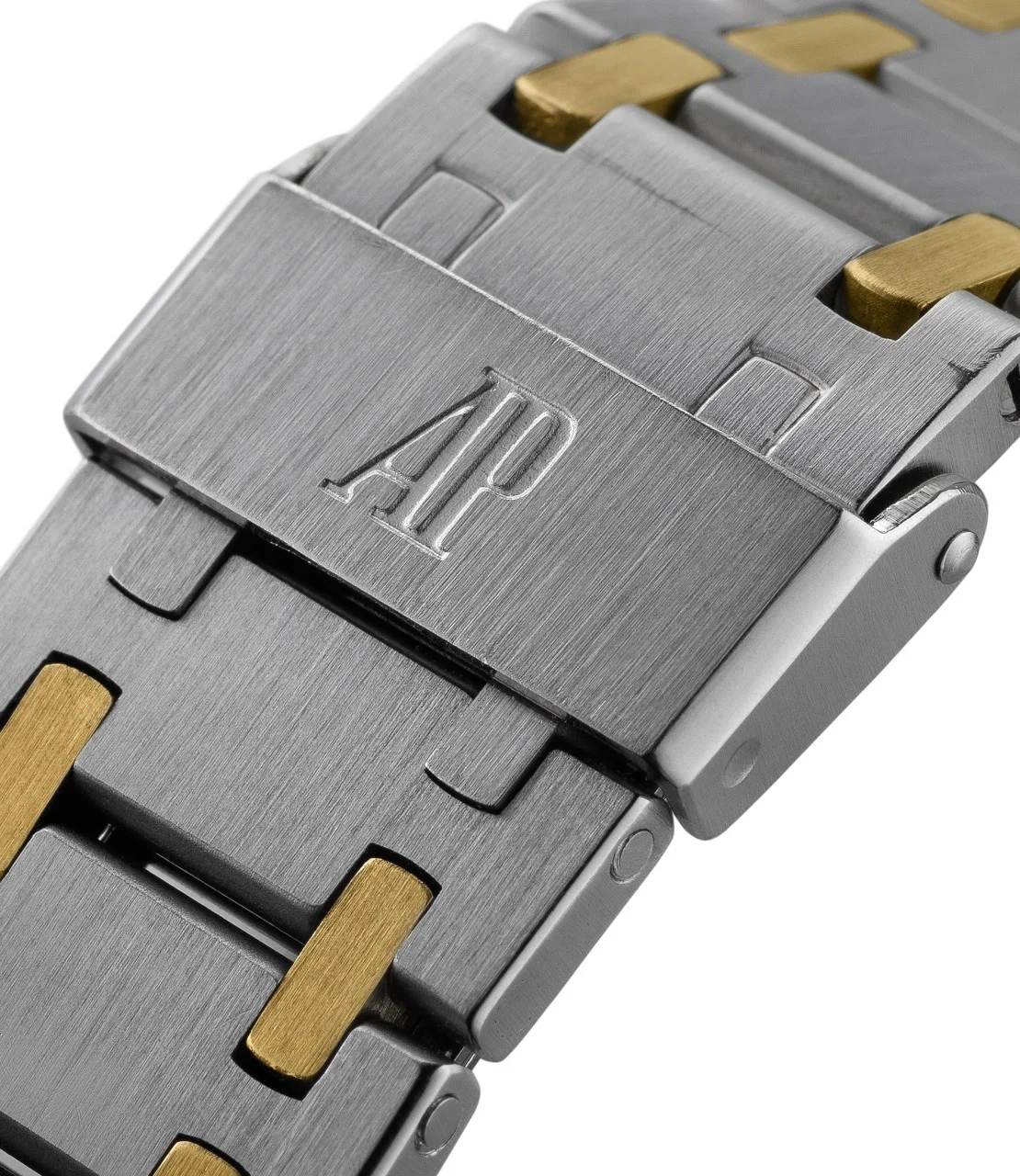
Collector’s Insight: Two-tone Royal Oaks require particular attention to the junction points where steel meets gold. On the bracelet, each alternating link must transition cleanly — no visible gap, no misaligned brushing direction. The bezel-to-case interface is equally critical: the rose gold octagon sits atop the steel case with a gasket between them, and the fit should be seamless enough that you cannot slide a hair between the two materials. This junction quality is often what separates an outstanding piece from an average one.
Full Rose Gold Royal Oak — References 15500OR and 15202OR
If two-tone is the gateway, full rose gold is the destination. And nobody does rose gold like Audemars Piguet. That claim is not marketing — it is metallurgy. AP’s proprietary 18k pink gold alloy contains a specific ratio of gold, copper, and palladium that produces a warmer, more reddish tone than standard rose gold while resisting the fading that plagues most pink gold alloys over time. Standard rose gold tends to lose its pink hue after years of wear as the copper oxidizes. AP’s formulation, sometimes called “AP pink gold” internally, maintains its color for decades.
Reference 15500OR — The Modern Full Rose Gold (41mm)
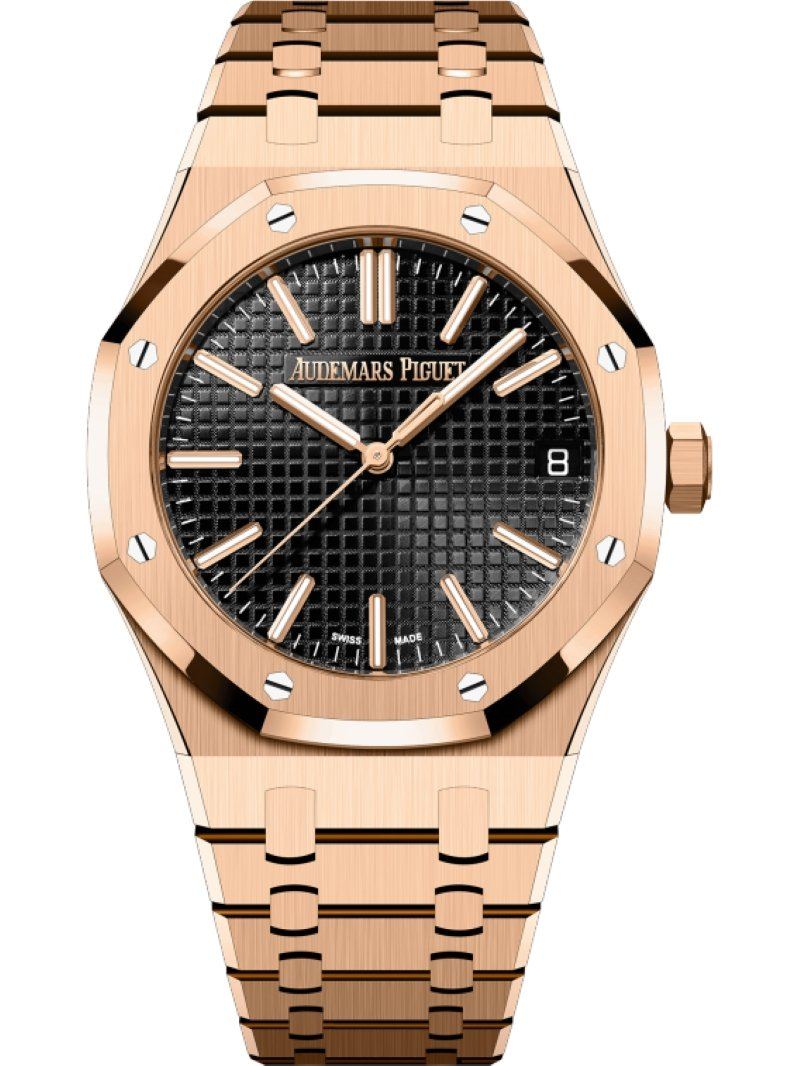
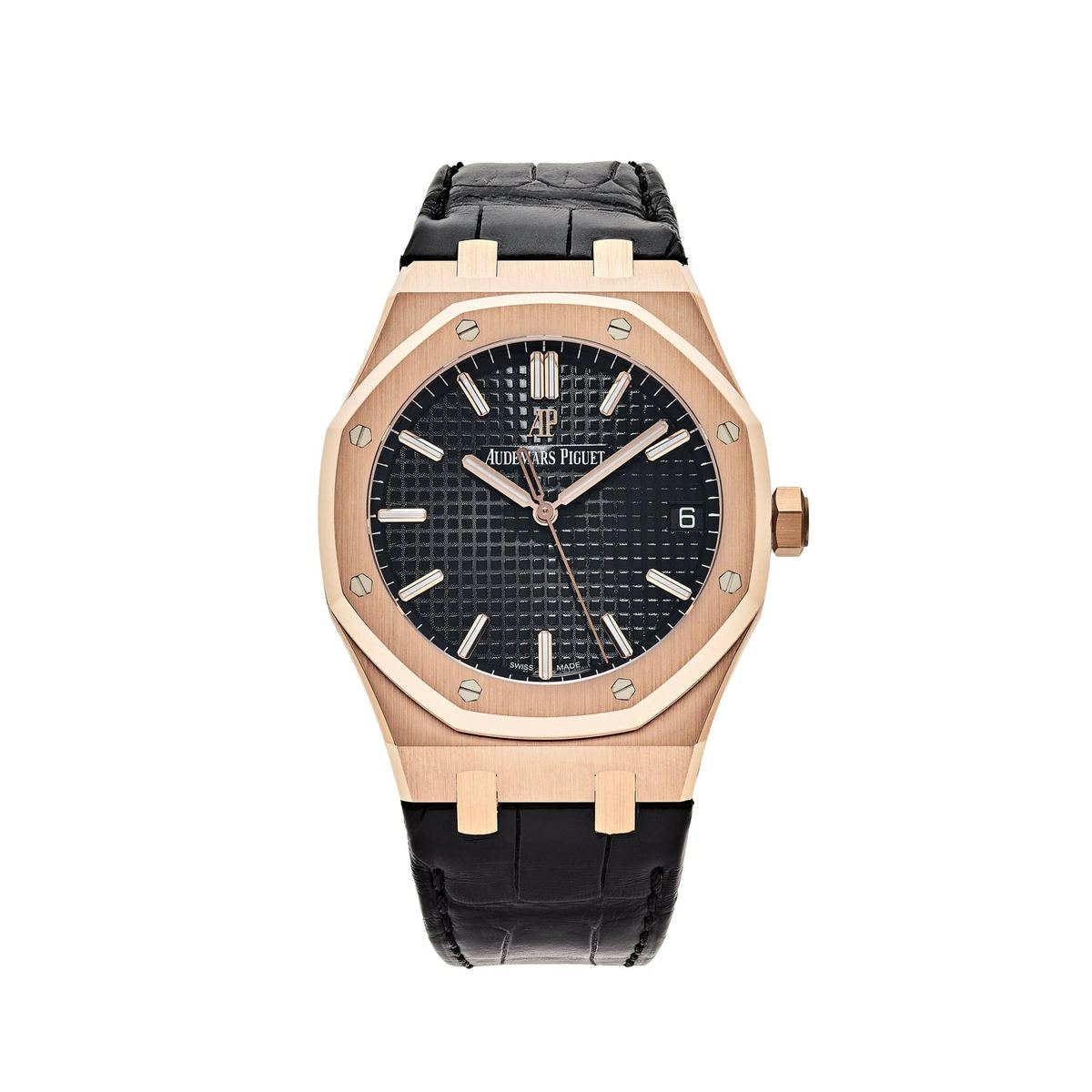
The 15500OR is the full 18k rose gold version of the current-generation 41mm Royal Oak. Same caliber 4302, same 70-hour power reserve, same case proportions — but every component that was steel in the 15500ST is now rose gold. The case. The bezel. The bracelet. The crown. Even the screws. The entire watch glows with that distinctive AP pink warmth.
There is a meaningful difference in how a full rose gold Royal Oak wears compared to the steel version. Weight goes from approximately 155 grams (steel on bracelet) to roughly 230 grams. That is a 48% increase in wrist presence. You know it is there. Every time you reach for a glass or turn a steering wheel, you feel the substantial density of gold. Some collectors find this addictive — the physical reminder that you are wearing something genuinely precious. Others find it fatiguing after a full day.
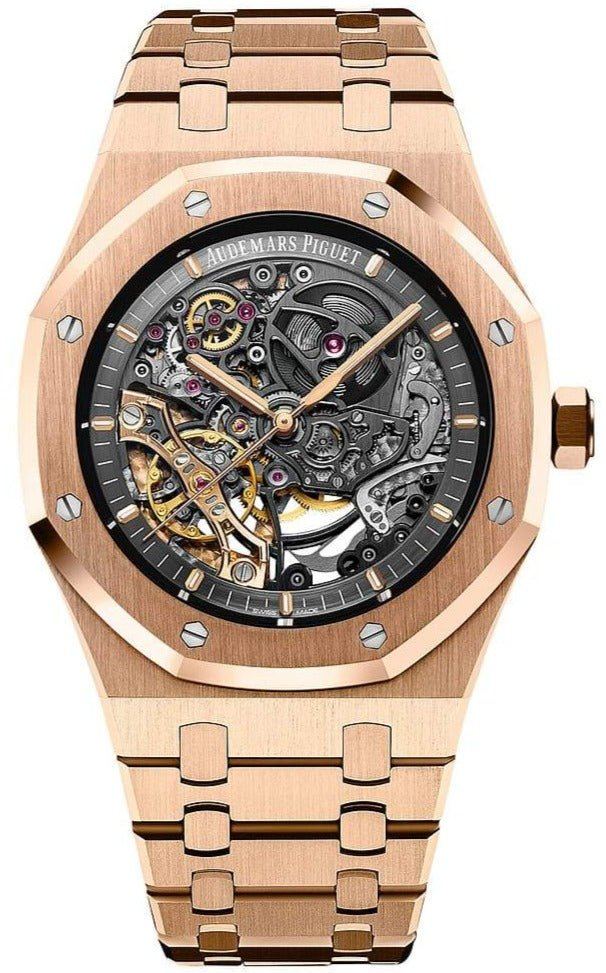
The ap royal oak rose gold replica in the 15500OR configuration demands meticulous attention to color matching. The rose gold tone must be consistent across every single component — bezel, case, bracelet links, crown, applied hour markers, hands. Any variation in shade between components breaks the illusion immediately. When everything matches, though, a full rose gold Royal Oak under warm lighting is one of the most visually striking objects in all of watchmaking. It manages to look both ancient and modern simultaneously — that coppery warmth recalls antique gold while the sharp Genta geometry keeps it firmly contemporary.
Dial options for the 15500OR include silver with rose gold-toned markers (the classic pairing), chocolate brown (a masterpiece of tonal coordination where the warm dial and warm case create an almost monochromatic effect), and blue (the highest contrast option, pairing cool blue against warm rose gold). My personal recommendation? The brown dial. It is the one that makes you stop and stare.
Reference 15202OR — The Rose Gold “Jumbo” (39mm)
Take everything magical about the 15202ST “Jumbo” — the 39mm case, the impossibly thin 8.1mm profile, the Grande Tapisserie dial, the legendary cal. 2121 — and execute it entirely in 18k rose gold. The 15202OR is, by any measure, the most refined Royal Oak ever produced. It is dress-watch thin. It is precious metal throughout. And it carries a movement that traces its lineage directly to 1972.
At 39mm in full rose gold, the 15202OR weighs considerably less than the 41mm 15500OR despite the same material density. The thinner case and smaller diameter bring the weight to around 190 grams — still heavier than steel, but balanced differently. It sits closer to the wrist, drapes more naturally, and the bracelet taper is even more pronounced because of the smaller endlink width. On a 17cm wrist, this watch looks like it was designed specifically for your arm.
AP discontinued the 15202 line in 2022, replacing it with the 16202 (which uses the new in-house cal. 7121 instead of the JLC-derived 2121). That discontinuation made the 15202OR even more collectible — it is the last rose gold Jumbo with the original movement DNA. For anyone building a serious Audemars Piguet collection, the 15202OR represents the apex of the Royal Oak in its purest form, executed in its most flattering metal.
Yellow Gold Royal Oak — The Classic References
Before rose gold conquered the luxury watch market, yellow gold was the default precious metal for the Royal Oak. The original 1972 ref. 5402 was offered in a yellow gold variant almost immediately after the steel version debuted, and for two decades, yellow gold Royal Oaks represented the pinnacle of AP’s catalog. They still carry serious weight among knowledgeable collectors.
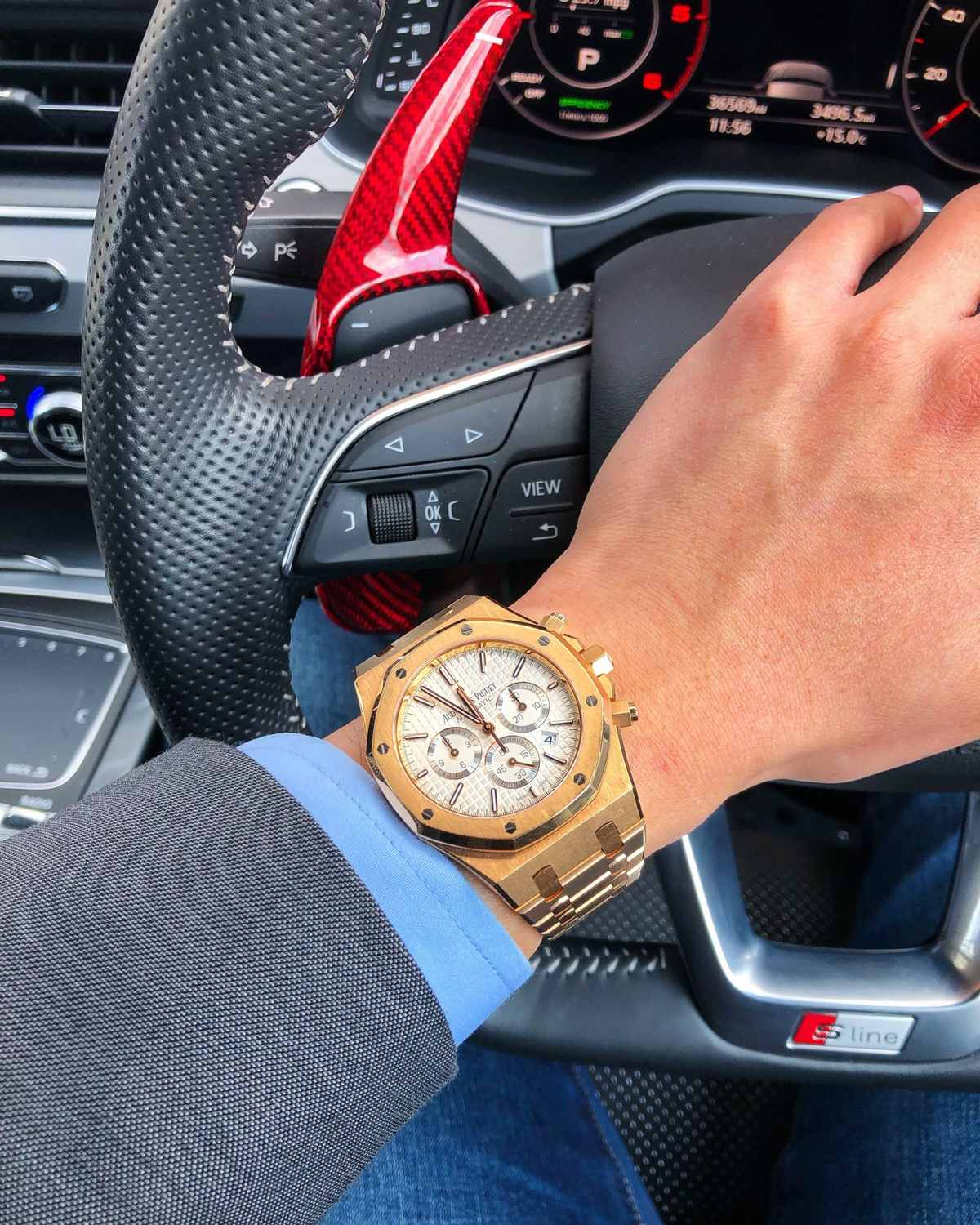
The ref. 15202BA is the Jumbo in 18k yellow gold — “BA” standing for “Boitier en or” (gold case). It shares every dimension with the 15202ST and 15202OR. But yellow gold creates a completely different character. Where rose gold is warm and subtle, yellow gold is warm and declarative. It catches light with more intensity. The tapisserie dial under a yellow gold bezel reflects a golden sheen across those tiny stamped squares that borders on hypnotic. This is not a watch for people who want to fly under the radar. This is a watch for people who have moved past caring what anyone thinks.
Current-generation yellow gold references include the 15510BA (41mm, cal. 4302) and the 26240BA (chronograph). AP also produces the Royal Oak in 18k white gold — references ending in “BC” — which reads almost like steel to the untrained eye but feels noticeably heavier on wrist due to gold’s density. White gold Royal Oaks are the true connoisseur’s choice: all the weight and material quality of gold with none of the visual announcement.
Expert Tip: Yellow gold Royal Oaks scratch more visibly than rose gold or steel. 18k yellow gold is softer (Vickers hardness around 135 HV versus 170-180 HV for typical rose gold alloys). If you wear a yellow gold Royal Oak daily, expect the bracelet and bezel to develop a patina of fine hairline scratches within weeks. Many owners consider this patina part of the charm — it softens the geometry and gives the watch a lived-in warmth. Others have their pieces polished annually. Neither approach is wrong.
For the AP gold watch replica collector deciding between yellow and rose gold, consider your wardrobe and your skin tone. Yellow gold pairs naturally with navy, black, and earth tones. Rose gold works with virtually everything — it is warmer than white metal but cooler than yellow gold, sitting in a comfortable middle ground. There is a reason rose gold has overtaken yellow in market share. It is simply more versatile on more wrists in more situations.
Why Rose Gold Became the Most Popular Precious Metal in AP
Walk into any authorized Audemars Piguet boutique today and count the rose gold pieces versus the yellow gold ones. The ratio will be roughly four to one. In 2010, it was closer to even. By 2015, rose gold had pulled ahead. By 2020, it was dominant. This shift did not happen by accident — it was driven by material science, cultural change, and one specific metallurgical advantage that AP exploited brilliantly.
First, the cultural shift. Rose gold’s rise coincided with a broader design movement toward warmer, softer aesthetics across fashion, architecture, and industrial design. The iPhone 6S launched in “Rose Gold” in 2015 and sold millions. Pantone named various warm pink and copper tones as trending colors throughout the late 2010s. Luxury cars — Rolls-Royce, Bentley — began offering rose gold interior accents. The entire visual environment warmed up, and watches followed.
Second, the skin-tone advantage. Yellow gold looks striking on darker skin tones but can appear garish on very pale complexions. White gold/platinum disappear against fair skin. Rose gold flatters nearly every skin tone on the spectrum. Its blend of warm copper and neutral gold creates a chameleon-like quality — it reads as warm against cool skin and rich against warm skin. For a global luxury brand selling to customers from Shanghai to Stockholm to Sao Paulo, that universality matters enormously.
Third — and this is the metallurgical advantage that AP specifically capitalizes on — rose gold is harder than yellow gold. The copper content that gives rose gold its pink hue also increases the alloy’s hardness. AP’s 18k pink gold formulation tests at approximately 175 HV on the Vickers scale, compared to roughly 135 HV for their 18k yellow gold. In practice, this means a royal oak rose gold bracelet resists scratching and deformation significantly better than a yellow gold one. The geometric precision of the Royal Oak’s design — those crisp edges, those flat-brushed surfaces — survives daily wear much longer in rose gold than in yellow gold. The architecture stays sharper.
AP also added palladium to their pink gold formulation sometime in the mid-2000s. Palladium serves two purposes: it stabilizes the color against oxidation (preventing the copper from darkening over decades of skin contact) and it increases corrosion resistance. Standard 18k rose gold without palladium can develop a slightly greenish tinge at the contact points after years of sweat exposure. AP’s formulation resists this degradation almost entirely. Your rose gold Royal Oak will look the same shade of pink in twenty years as it does today, assuming you keep it reasonably clean.
The result of all this? When you pick up an AP Royal Oak in rose gold, you are holding a watch made from a metal alloy that was specifically formulated for this exact application. It is not generic 18k rose gold. It is AP’s rose gold — harder, more stable, and slightly warmer in tone than what you will find on any competitor’s wrist. That specificity is part of what you are paying for, and part of what makes the rose gold Royal Oak feel different from a rose gold Nautilus or a rose gold Overseas.
Complete Reference Table: Two-Tone and Gold Royal Oak Models
Below is the master reference list for every significant two-tone and gold Royal Oak. I have included discontinued references where they remain relevant to collectors — which, in the case of the 15202 Jumbo line, very much applies.
Rose Gold vs. Yellow Gold vs. Two-Tone — Side-by-Side Comparison
What to Look for in a Gold or Two-Tone Royal Oak Replica
Gold Royal Oak replicas separate the serious collectors from the casual buyers faster than any other model category. The reason is simple: getting steel right is hard. Getting gold right is exponentially harder. Color, weight, finishing, wear behavior — every aspect compounds in difficulty when precious metals enter the equation. Here is what to evaluate.
Color consistency across components. This is the single most revealing test. Lift the watch under warm incandescent light and examine the bezel, the case sides, the bracelet links, the crown, and the applied markers. All rose gold components must match in shade. Even a slight variation — one shade pinker on the bezel versus a more coppery tone on the links — signals inconsistent plating or different alloy batches. On the genuine 15500OR, AP machines all components from the same alloy melt to ensure perfect color matching. The best replicas follow this principle. Many do not.
Transition zones on two-tone models. Where steel meets gold on the 15550SR, there is a hairline junction. On the genuine watch, this junction is virtually invisible — the two metals meet with a tolerance measured in hundredths of a millimeter. In the bracelet, alternating links should have identical dimensions regardless of material. No stepping. No visible gap. The rose gold links should be the same width and thickness as the steel links flanking them. Run your fingernail across the junction. You should feel nothing.
Weight calibration. A full rose gold 41mm Royal Oak weighs approximately 230 grams. A steel one weighs roughly 155 grams. If someone hands you a “rose gold” Royal Oak that weighs under 200 grams, the gold is not what it claims to be. Weight is physics — you cannot fake density. A properly weighted ap royal oak rose gold replica should feel substantively different from a steel one. If they feel similar on wrist, something is off.
Polishing quality on gold surfaces. Gold is softer than steel, which means it takes a polish differently. Brushed gold surfaces should have a slightly warmer, more reflective quality than brushed steel — the brush marks catch and scatter light with more intensity. The polished chamfered edges on a rose gold bezel should be mirror-grade, without any micro-pitting or waviness. Hold the bezel at a 45-degree angle to a light source. The polished edge should reflect a clean, undistorted line. Any waviness means the finishing is substandard.
For those evaluating their first gold AP purchase, start with the two-tone option. The 15550SR configuration gives you the visual impact of rose gold where it matters most — the bezel and the bracelet highlights — while the steel body provides structural familiarity. It is also easier to assess: you can judge the gold quality by comparing it directly to the steel components right there on the same watch.
Collector’s Verdict: Among all gold Royal Oak references, the 15500OR with the chocolate brown dial remains my personal favorite. The tonal harmony between the warm brown tapisserie and the pink gold case creates an almost monochromatic effect that photographs beautifully and wears even better. If you are assembling a two-watch collection, pair it with a steel 15510ST in blue — you will have every situation covered, from boardrooms to barbecues.
Frequently Asked Questions
What is the difference between AP references ending in OR, BA, and SR?
AP uses a suffix code to identify the case material. “OR” stands for “Or Rose” — rose gold. “BA” stands for “Boitier en or” and typically indicates yellow gold. “SR” denotes a two-tone combination of steel (“S”) and rose gold (“R”). “BC” is white gold, and “ST” is stainless steel. Once you learn these suffixes, you can immediately identify the material of any Royal Oak reference without looking it up.
Does AP’s rose gold fade or change color over time?
Audemars Piguet’s proprietary 18k pink gold alloy is stabilized with palladium, which prevents the copper component from oxidizing and darkening. Unlike standard rose gold alloys that can lose their pink warmth over decades of skin contact, AP’s formulation maintains its original color profile almost indefinitely. The watch will accumulate surface scratches with wear, but the underlying metal tone stays consistent. A quality AP gold watch replica should replicate this color stability — the rose gold finish should resist tarnishing and discoloration through normal use.
Is a two-tone Royal Oak a good first luxury watch choice?
Absolutely, and arguably a better first choice than a full gold model. The two-tone 15550SR gives you the visual warmth of rose gold — the bezel and alternating bracelet links — combined with the durability of steel for the case body and outer bracelet links. It pairs with virtually any outfit, from a linen shirt to a wool suit. The weight sits between steel and full gold, which makes it comfortable for daily wear from day one. Many collectors start with two-tone and later add a full steel or full gold piece to their rotation.
Which dial color works best with rose gold?
Three options dominate and each serves a different purpose. The chocolate brown dial creates a warm, monochromatic look — the dial and case flow together tonally, producing an exceptionally refined appearance. The silver dial offers classic contrast — cool silver tapisserie against warm rose gold bezel and bracelet, highlighting the geometric architecture. The blue dial is the statement choice — the cool-versus-warm contrast is dramatic, especially under natural light. For everyday versatility, silver. For maximum visual impact, brown. For compliments from strangers, blue.
How much heavier is a rose gold Royal Oak compared to steel?
A full 18k rose gold Royal Oak in 41mm weighs approximately 230 grams on its bracelet, compared to roughly 155 grams for the all-steel version — a difference of about 75 grams or 48% heavier. That sounds marginal on paper, but on wrist the difference is immediately obvious. The gold version has a gravitational quality: it sits heavier, rotates on the wrist less, and you are always aware of its presence. The two-tone 15550SR splits the difference at around 185 grams. If you have never worn a gold sports watch before, try one on for at least ten minutes before committing. The weight is either addictive or exhausting — people rarely feel neutral about it.
Bringing It All Together
The AP Royal Oak rose gold replica sits at the intersection of everything that makes this watch great: Genta’s geometric architecture, AP’s proprietary metallurgy, and a warmth that steel — no matter how beautifully finished — cannot replicate. Whether you choose the two-tone 15550SR for its balanced everyday elegance, the full rose gold 15500OR for sheer visual power, or the discontinued 15202OR Jumbo for collector credibility, you are choosing a watch that speaks a specific language. Gold on a Royal Oak is not decoration. It is emphasis.
I have spent three decades handling Royal Oaks in every metal AP offers, and my conviction has only grown stronger: the royal oak rose gold is where this design reaches its full expressive potential. Steel is the origin story. Rose gold is the climax. And two-tone — that disciplined mix of warm and cool — is the chapter most people keep re-reading.
Judge the metal matching. Test the weight. Run your finger across the bracelet transitions. The details that separate exceptional from ordinary are all tactile — you cannot evaluate them from photographs. The rose gold Royal Oak rewards anyone willing to slow down and pay attention. And that, ultimately, is the entire point of a watch like this. It makes you stop, look closely, and appreciate the meeting of craft and material at the highest level.

